Exogenous Lactate Fuelling: the Preferred Source of Energy | Exolactate
Before anything else, allow me a few personal lines, my dear lector. It has been more than three years since I last wrote here, on this blog, and I could not start again without saying one thing first: thank you.Thank you for waiting, thank you for still being on the other side of the screen, thank you for every message asking when the next post would arrive.
These years have not been a silence — they have been an impasse full of work. I have grown a lot, as a professional and also as a person: new projects, new research, new questions, new people that have changed the way I look at physiology and nutrition. Glut4Science was never abandoned; it was simply waiting for me to come back with more and better things to share. And here we are. This post is the first of that new chapter, and I genuinely believe it is the most ambitious one I have written so far.
In the meantime, if you want to follow the day-to-day — the ideas, the field work, the things that do not always fit in a long post — you can find me on Twitter and Instagram as @Glut4Science. I would love to keep the conversation going there too. Now yes, let’s begin.
Introduction
For almost the whole twentieth century, lactate was the villain of human physiology. It was the molecule we blamed when our legs turned into stone in the last kilometres of a race, the supposed acid that “burned” the muscle, the metabolic waste that the body produced when it could not keep up anymore. Generations of athletes, coaches and even physiologists grew up believing one simple idea: that lactate was the enemy.
And this is a curious thing, because villains are almost never invented from nothing. They are, usually, just misunderstood. The history of lactate is, above everything else, the history of a big misunderstanding — and, like every good story of redemption, it deserves to be told from the beginning.
Let me take a small detour here, because I really think it matters. The word "lactate" comes from the Latin lac, milk. It was named in 1780 by the Swedish chemist Carl Wilhelm Scheele, who isolated it for the first time from soured milk — and so, lactate was born associated with fermentation, with that slow chemistry that humans have used for thousands of years to preserve what otherwise would be lost. Long before any chemist gave it a name, our ancestors were already building entire cultures around this molecule: the nomads of the Mongolian steppe fermenting mare's milk into airag, the shepherds of Anatolia turning milk into yoghurt inside pouches of animal skin, the villages of the Andes, Korea and Central Europe souring cabbage, milk and grain long before they could explain why it did not rot. They did not have a word for Lactobacillus, but they had something better: they had the practice. They knew, in their hands and in their kitchens, that this sour chemistry meant survival through the winter.
So lactate, from the very beginning, was never a waste product. It was a way of storing energy, a tool for survival, a piece of human culture. It is almost ironic that modern physiology spent decades insisting on exactly the opposite.
It took us almost two centuries to bring that old intuition into the laboratory. Today we know that lactate is not the product of a failing engine, but one of the most elegant currencies of human metabolism: a molecule that travels between tissues, that connects the fast and the slow, the glycolytic and the oxidative. The athlete who once feared it was, in reality, producing one of his most valuable fuels.
This post is about taking that idea one step further. If our own body treats lactate as something precious, what happens if we decide to give it lactate from the outside? Welcome, then, to the story of exogenous lactate.
What we know about lactate
Let me put the science on the table first, briefly, because everything that comes after depends on it.
The old paradigm that linked lactate accumulation with acidosis and fatigue has been clearly superseded by a much more integrative framework. Lactate is today recognized as a central intermediary of carbohydrate metabolism, working at the same time as a circulating energy substrate and as a signalling molecule.The conceptual key here is the lactate shuttle, a theory that we owe, in good part, to more than forty years of patient and courageous work by George Brooks — often against the dominant paradigm of his time. In his model, lactate produced in the highly glycolytic fibres (type II) is exported through MCT4 transporters and taken up by oxidative tissues through MCT1, where it is converted back to pyruvate and oxidized inside the mitochondria, feeding the TCA cycle. It is, in essence, a system that allows one tissue to fuel another one.
And the quantitative weight of this molecule is not a small thing. During exercise, lactate turnover rates can be even higher than the ones of glucose itself, and this tells us something important: this is not a marginal metabolite, this is a protagonist. The heart and the neurons, in fact, prefer lactate as a fuel during the periods of high energy demand. If we add to this its role as a “lactormone” — a signalling molecule able to activate the HCAR1/GPR81 receptor and to modulate transcriptional programmes like PGC-1α, linked to mitochondrial biogenesis — the picture becomes very clear: as Brooks himself beautifully puts it, lactate is a fulcrum of metabolism. We stand, in this whole conversation, on his shoulders.
Now, here is the part that interests me the most as a practitioner. Everything I have described until now is about endogenous lactate, the one that our own glycolysis produces. But, what about exogenous lactate, the one that we could ingest? The honest answer is that we know much less. Tracer studies suggest that exogenous lactate could be used quickly, with oxidation kinetics that might be comparable to the ones of glucose, and that, because it skips the upper glycolytic steps, it could feed oxidative phosphorylation in a quite efficient way. So, from a mechanistic point of view, the promise looks big. But between a promise and a fueling strategy that an athlete can really use in a race, there is a long road. And we should be very careful, because today almost nothing is yet demonstrated in this field. Let’s see now why.
Why exogenous lactate is not a reality yet
If exogenous lactate is so promising, the obvious question appears immediately: why is not every endurance athlete using it already? Why is it not sitting on the shelf, just next to the gels and the carbohydrate drinks?
The answer, my dear lector, is that physiology and practice are not the same thing. Exogenous lactate finds three very real walls in front of it.
The first wall is the dose. Tracer and infusion studies suggest that, to contribute in a meaningful way to whole-body energy metabolism, we would need sustained intakes around ~10–25 g·h⁻¹. During a long event of three to five hours, this means cumulative intakes of 30 to 125 g of lactate — numbers that are comparable to the established carbohydrate strategies. The early oral studies, on the contrary, used tiny doses (sometimes as low as ~500 mg·h⁻¹) and they failed to produce any meaningful physiological or performance effect. They were not really testing the hypothesis; they were testing an almost homeopathic version of it.
The second wall is the osmotic and ionic load. And here is, for me, the real problem. To deliver lactate orally we have traditionally used salts — sodium lactate, calcium lactate. But reaching 10–25 g·h⁻¹ of lactate using salts would force the athlete to swallow an excessive load of sodium or calcium, with a direct risk of gastrointestinal distress and electrolyte imbalance. And anyone who has worked in the field knows this well: the gut is, very often, the true limiting organ in endurance performance. A fuel that destroys the gut is not a fuel.
The third wall is palatability. And this one is almost never discussed, but it is decisive. Lactate salts are unpleasant. They taste salty, metallic, and they are very hard to drink hour after hour while you are running or riding at competition intensity. There is something almost poetic in this detail: the same fermentation that humans have loved for millennia in cheese, in sourdough, in wine, gives us here a sour note that the athlete’s palate simply rejects in the middle of a race. We can design the most elegant metabolic strategy in the world, but if the athlete can not tolerate it — physically and also sensorially — during four hours, then it simply does not exist as a practical tool.
To these three walls we should add a more subtle one: oral lactate, because of its hepatic metabolism and the cations that come with it, may produce a systemic alkalinization. A mild alkalosis could even be useful, as a buffer; but losing the control of the acid–base balance could impair enzymatic function and excitation–contraction coupling. As the old wisdom of Paracelsus reminds us, the dose makes the poison — and that is as true for lactate as for anything else.
So this is, honestly, where we are today: a molecule with a spectacular mechanistic rationale, and no feasible way — that we are aware of — to deliver it orally at the rates that are needed during endurance exercise. Frustrating? Maybe. But this is exactly the kind of gap that, historically, has come just before the most interesting advances.
The solution may be much closer than we think
Because here is the thing: science has solved problems like this one before. And mostly if those problems where related to engineering .
A few years ago, exactly the same was said about ketones. To deliver exogenous ketones in meaningful amounts looked impossible — until the development of ketone esters made possible a safe and effective delivery at high doses, even up to 20 g·h⁻¹. The same logic transformed carbohydrate intake: hydrogel technology improved the delivery efficiency and the gastric tolerance, and helped to turn intakes that once sounded crazy — 90, 120 g·h⁻¹ — into a normal part of the elite athlete’s toolbox. I know that story quite well, because part of my own research career has been dedicated exactly to push that boundary.
The lesson could be clear. The barrier in front of exogenous lactate might not be biological, but pharmacotechnical. And the barriers of formulation are, precisely, the kind of barriers that engineering and food science already know how to take down. If our ancestors learned to tame fermentation with a goat-skin pouch and a bit of patience, it would be strange to think that we, with modern food technology, could not tame the delivery of a single small molecule. Lactate esters, combined and polymer-based salt formulations, hydrogel systems, nano- and micro-encapsulation — every one of these strategies could attack, in a direct way, the three walls that I described above: they could raise the deliverable dose, reduce the ionic load, and improve the palatability.
And this is, in good part, the question that has shaped my own professional path during these last years, from my initial obsession with this molecule 7 years ago, to the scientific journey of the last 3 years. Together with a small team of people that I admire and trust (Daniel Lasa, Juan Carlos Arboleya and Leire Izagirre), I had the privilege of co-founding From Lab to Field, a company whose name says, almost shyly, exactly what it tries to do: to take the science out of the paper and bring it, with all its limits and humility, into the hands — and the bottles, the gels, or whatever solution — of the athlete who actually uses it. And of course, we are based in our home place: The Basque Country.
Being honest, we have not invented lactate – of course not, please!! – but we have understood how to build a refined delivery of lactate exogenously. The road from a published mechanism to a product that an athlete can tolerate during four hours of competition is much longer, slower and more humbling than it looks from the outside. There are dozens of small problems that nobody writes papers about — a strange aftertaste, a granule that does not dissolve well, a stomach that protests after the second hour — and every one of them has to be solved, one by one, in the field. That is the part of the work that I love the most, and also the part that has taught me the most.
What I can tell you is that From Lab to Field was born exactly to live inside that gap between the laboratory and the road. We work side by side with food technologists, formulators, physiologists, and — most important of all — with the athletes themselves, who are always the most honest reviewers of any product. Many of the ideas that appear in this post are not just theory for us; they are problems that we are actively trying to solve, with all the limitations and the slowness that good work demands. And the field of exogenous lactate is, today, one of those open questions on our table.
So, when I say that the solution is much closer than we think, I am not really pretending big things. I am simply sharing that, after years of work, we begin to see how the puzzle could be put together — even if many pieces are still missing.
In our group we have been already studying and exploring exogenous lactate for some time now, and at this moment we have two internal studies underway. They are not published yet, so I am not going to anticipate any conclusion — that would not be honest, and honesty is part of how we work here. But I can tell you that we are generating data, that the questions we are asking are sharp, and that we will share those findings with you when the moment is right. Please, take this post just as a first mark on the trail. There is more coming.
What to expect: the dual-fuel idea
Let me now connect the mechanism with the practice, briefly, because this is the part that becomes really exciting for the endurance athlete.
We already know that exogenous carbohydrate oxidation has a ceiling — around 1.5–1.8 g·min⁻¹ — mostly because the intestinal glucose transporters (SGLT1) and the fructose transporters (GLUT5) get saturated at high intake rates. There is, in other words, a limit on how much energy we can push into the bloodstream using only carbohydrates.
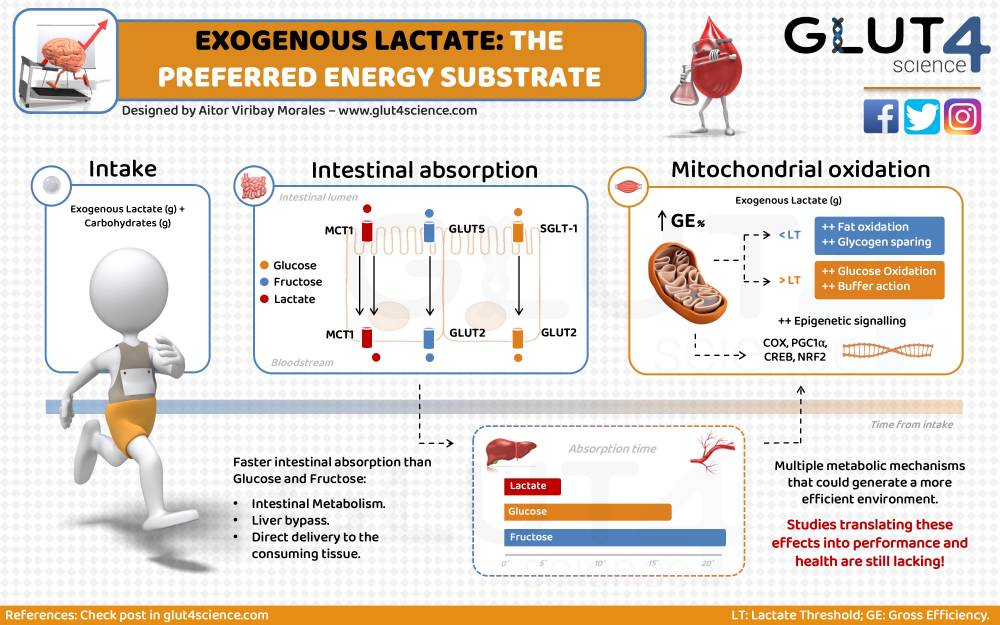
And here comes the elegant part. Lactate does not use those transporters. It is absorbed through the monocarboxylate transporters, mainly MCT1, a parallel and non-competitive intestinal pathway. This is the heart of what we could call the dual-fuel model: if carbohydrates travel through one door (SGLT1, GLUT5) and lactate travels through a different one (MCT1), then co-ingesting both could, in theory, raise the total ceiling of exogenous energy availability — carbohydrates giving their ~90–120 g·h⁻¹, and lactate potentially adding a complementary ~10–25 g·h⁻¹ on top — without the two substrates fighting each other at the gut wall. The infographic that goes with this post shows the idea quite well: three substrates, three doors, one shared bloodstream. It is, for now, an attractive hypothesis — not a confirmed fact.
Once it is absorbed, what could that lactate do? Its role looks context-dependent, and it could be governed by the exercise intensity — and this is the distinction that I find the most useful, even if much of what follows is still working hypothesis:
Below the lactate threshold, at low-to-moderate intensity, exogenous lactate could behave as a clean oxidative substrate. Taken up through MCT1, converted into pyruvate, fed into the TCA cycle, it might reduce the dependence on glycolytic carbohydrate breakdown and contribute to glycogen sparing. It could even allow, and this is almost paradoxical, a relative increase of fat oxidation at the muscle. And, as a gluconeogenic precursor, it might support the Cori cycle and help with glycemic control. In plain words: it could help to protect your glycogen, which is your most precious and most finite reserve.
Above the lactate threshold, at high intensity, the role could change. Here exogenous lactate might help to sustain gross efficiency by reinforcing the carbohydrate-derived oxidative metabolism — which has a lower oxygen cost than fat. It could buffer the cytosolic NADH/NAD⁺ ratio, helping to stabilize the redox balance that keeps fast glycolysis and oxidative phosphorylation coupled together, and its proton handling may help to cushion the local pH disturbances. Potentially, then: more ATP, less oxygen cost, and a better-defended pH.
The same molecule, then, could play two different instruments depending on the tempo of the race. And in both cases it would do it next to the carbohydrates, not instead of them. This is the key message that I want you to keep with you: exogenous lactate is not a replacement for carbohydrate fueling — it could be a complement, one that may finally help us to go past a ceiling that we have been hitting for years.
Conclusions
Lactate has travelled a long way. From the soured milk inside Scheele’s flask, from the goat-skin pouches of nomadic shepherds, to the misunderstood villain of the twentieth century, to the central currency of metabolism that we recognize today. And now it stands in front of one more transformation: from a molecule that the body produces, to a molecule that the athlete might decide, on purpose, to consume.
I want to be honest about where we are. Exogenous lactate supplementation is still in its infancy. The mechanistic rationale is compelling, the dual-fuel logic is elegant, and the formulation tools that already worked for ketones and for carbohydrates give us good reasons to be optimistic. But we still do not have the definitive delivery system, we still do not have the long-term performance data, and we still do not know the optimal doses, timings or combinations. We have a hypothesis with strong foundations — not a finished answer.
And that, for me, is the best part of all. Because this is exactly the moment of a research line that I find the most stimulating: the moment when the questions are still many more than the answers. There is a famous idea, often attributed to the explorers of the last century, that the map is not the territory — and right now, with exogenous lactate, we have barely sketched the first lines of the map. There is a long road ahead — of laboratory work, of clinical trials, of trial and error in the field with real athletes.
The villain of the past may well become one of the protagonists of the future of sports nutrition. But that future still has to be earned — one experiment at a time.
Thank you so much for reading me. See you soon!
If you want to be updated with my latest publications, you can subscribe here to my list.
Versión en castellano:
English version:
References
Brooks GA. Lactate as a fulcrum of metabolism. Redox Biol. 2020;35:101454. [link]
Brooks GA. The Science and Translation of Lactate Shuttle Theory. Cell Metab. 2018;27:757–85. [link]
Brooks GA. What the Lactate Shuttle Means for Sports Nutrition. Nutrients. 2023;15:2178. [link]
Gladden LB. Lactate metabolism: a new paradigm for the third millennium. J Physiol. 2004;558:5–30. [link]
Hui S, Cowan AJ, Zeng X, et al. Quantitative Fluxomics of Circulating Metabolites. Cell Metab. 2020;32:676–
688. [link]
Miller BF, Fattor JA, Jacobs KA, et al. Lactate and glucose interactions during rest and exercise in men: effect of
exogenous lactate infusion. J Physiol. 2002;544:963–75. [link]
Pedersen MGB, Søndergaard E, Nielsen CB, et al. Oral lactate slows gastric emptying and suppresses appetite in
young males. Clin Nutr. 2022;41:517–25. [link]
Murray AJ, Knight NS, Cole MA, et al. Novel ketone diet enhances physical and cognitive performance. FASEB J.
2016;30:4021–32. [link]
Pettersson S, Ahnoff M, Edin F, et al. A Hydrogel Drink With High Fructose Content Generates Higher Exogenous
Carbohydrate Oxidation. Front Nutr. 2020;7:88. [link]
Urdampilleta A, Arribalzaga S, Viribay A, et al. Effects of 120 vs. 60 and 90 g/h Carbohydrate Intake during a Trail
Marathon on Neuromuscular Function and High-Intensity Run Capacity. Nutrients. 2020;12:2094. [link]
Related articles
120 grams of Carbohydrates per hour During Exercise Improve Recovery — Viribay A — Glut4Science.
Fat Oxidation in Athletes: High Carbohydrate versus High Fat Diet — Viribay A — Glut4Science.

Autor :Aitor Viribay
Comentarios (0 comentarios)
Este artículo no tiene comentarios